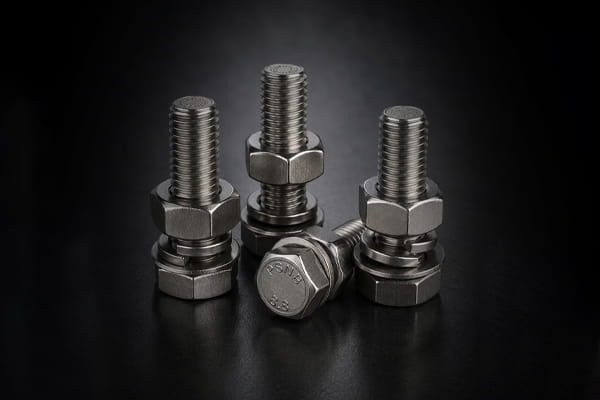
Look at the head of a metric bolt and you will usually find two numbers separated by a dot — 4.6, 8.8 or 10.9. This is the property class, defined in ISO 898-1 and the matching Indian Standard IS 1367 (Part 3). It is the quickest way to know how strong a bolt is.
How to read the numbers
- The first number × 100 gives the nominal tensile strength in MPa (N/mm²).
- The second number ÷ 10 gives the ratio of yield strength to tensile strength.
So a class 8.8 bolt has a nominal tensile strength of 800 MPa, and its yield strength is 0.8 × 800 = 640 MPa.
| Property class | Nominal tensile strength | Nominal yield strength | Typical use |
|---|---|---|---|
| 4.6 | 400 MPa | 240 MPa | General structural and fabrication work |
| 5.6 | 500 MPa | 300 MPa | General engineering |
| 8.8 | 800 MPa | 640 MPa | High-strength structural and machinery joints |
| 10.9 | 1000 MPa | 900 MPa | Highly loaded machinery and preloaded joints |
| 12.9 | 1200 MPa | 1080 MPa | Special high-strength applications |
Match the nut to the bolt
Nuts have their own property classes — a single number such as 5, 8 or 10 — which corresponds to the first number of the bolt class they are designed to work with. As a rule, use a nut of at least the matching class: an 8.8 bolt with a class 8 nut, a 10.9 bolt with a class 10 nut. A weaker nut can strip before the bolt reaches its intended load.
Stronger is not always better
It is tempting to specify the highest class everywhere, but higher-strength bolts are less ductile, more sensitive to hydrogen embrittlement when electroplated, and only deliver their benefit when they are tightened to a proper preload. Use the class your design calls for — and do not mix classes in the same joint.
Specifying the class on your order
Always state the property class on the order line, alongside the size and length. If you are replacing existing bolts, check the head marking of the bolts coming out. Our IS 1363 guide covers dimensions and thread pitch, and our team can help if the application is unclear.